10 Best GitHub Repositories for Developers in 2026 (AI, Web & Python)
These 10 GitHub repos can help developers build faster in 2026, from AI coding agents to web apps and Python tools. Compare use cases and visit each official repo.
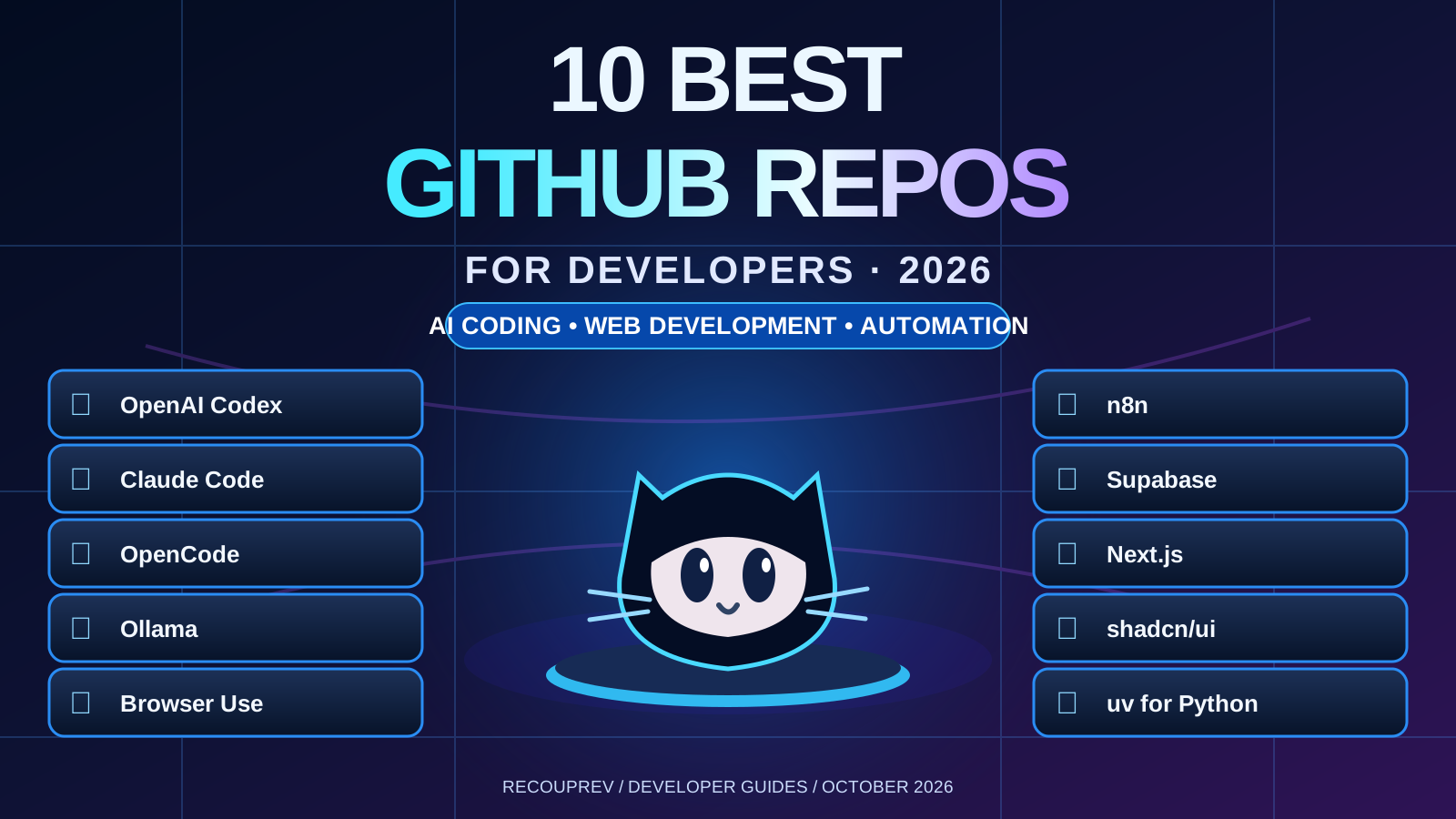
Developers searching for the best GitHub repositories in 2026 face an unusually crowded landscape. AI coding agents can modify multiple project files, open-source model runners can power local experiments, and established frameworks continue to make full-stack applications faster to build. A popular repository is not automatically the right one: examine its documentation, maintenance, licensing, security practices and compatibility with your stack before you adopt it.
We reviewed the official repository pages for ten practical tools spanning AI, web development, Python, databases and automation. This is an editorial recommendation organized by use case, not a ranking of star counts or a claim that we have independently benchmarked every repository. The GitHub links below go directly to the developers' projects. Product features, pricing and licenses may change after the October 26, 2026 editorial cutoff.
Quick comparison: the 10 GitHub repositories
OpenAI Codex (openai/codex) — AI coding agents. Official repository: https://github.com/openai/codex
Claude Code (anthropics/claude-code) — codebase maintenance. Official repository: https://github.com/anthropics/claude-code
OpenCode (anomalyco/opencode) — open-source coding assistant. Official repository: https://github.com/anomalyco/opencode
Ollama (ollama/ollama) — local AI models. Official repository: https://github.com/ollama/ollama
Browser Use (browser-use/browser-use) — browser automation. Official repository: https://github.com/browser-use/browser-use
n8n (n8n-io/n8n) — API workflows. Official repository: https://github.com/n8n-io/n8n
Supabase (supabase/supabase) — PostgreSQL backend. Official repository: https://github.com/supabase/supabase
Next.js (vercel/next.js) — full-stack React. Official repository: https://github.com/vercel/next.js
shadcn/ui (shadcn-ui/ui) — UI components. Official repository: https://github.com/shadcn-ui/ui
uv (astral-sh/uv) — Python project tools. Official repository: https://github.com/astral-sh/uv
1. OpenAI Codex: AI coding from the terminal
GitHub repository: https://github.com/openai/codex
OpenAI's Codex coding agent is designed for working with development projects from the command line. Developers can explore a codebase, investigate bugs and propose targeted edits without pasting the same background information into a separate chat repeatedly. It is useful when you have an existing application and want help understanding how the pieces fit together, not merely generating a standalone snippet.
Start with a contained experiment: clone a small test repository, ask Codex to identify an untested function, write an appropriate test, then review every proposed change and run the test yourself. Keep source-control checkpoints so you can undo incorrect changes. The publicly accessible repository does not guarantee free access to the underlying models; verify your plan or API costs.
2. Claude Code: inspect and maintain existing codebases
GitHub repository: https://github.com/anthropics/claude-code
Claude Code is Anthropic's agentic coding interface for terminal-driven workflows. It is especially relevant for engineering teams investigating how unfamiliar modules interact, preparing multi-file refactors and understanding the risks of a proposed change. The important difference from copying code into a browser is that the agent works in the context of the project, with appropriate tool permissions.
A practical first task is asking it to map an application's authentication flow, identify which files enforce permissions and outline tests required by a change. Do not merge generated refactors without review. The GitHub project is public, but licensing terms and model access are separate matters; verify the current terms before business use.
3. OpenCode: flexible open-source AI development
GitHub repository: https://github.com/anomalyco/opencode
OpenCode appeals to developers who want an openly developed, configurable coding-agent workflow rather than a single proprietary interface. Its terminal-based approach can accommodate different supported model providers, helping developers compare workflows and cost structures. It is a useful option for developers experimenting with AI coding tools in a repeatable environment.
To evaluate it, create a sample program with one known bug, configure a supported model and ask OpenCode to explain the failing behavior before writing a patch. The outcome should be assessed with tests and code review, not only whether the agent sounded confident. Provider API calls may still have fees, and local model choices depend on hardware.
4. Ollama: run supported language models locally
GitHub repository: https://github.com/ollama/ollama
Ollama gives software developers a way to run supported models locally and connect applications to them through an API. Its biggest appeal is control of the experimentation environment: you can prototype chat features, text processing and locally executed model workflows without placing every request through a remote inference endpoint.
A useful exercise is to connect a short Python or JavaScript script to an Ollama model, measure response speed and memory use, and determine whether the answers are accurate on your own test cases. Availability and speed depend on the model, system RAM, GPU and operating system. Some model licenses place separate restrictions on use or redistribution.
5. Browser Use: create experimental browser agents
GitHub repository: https://github.com/browser-use/browser-use
Browser Use provides Python tooling for agents that navigate websites and interact with browser elements. It is relevant to developers investigating user-interface testing, browser-driven information gathering and multistep automation, where an AI model needs structured access to the page rather than another text-only prompt.
Build your first prototype against a local demonstration website: navigate between pages, populate a dummy form and stop before submission. Record every agent action and require explicit human confirmation for sensitive operations. Browser agents can misunderstand UI state or encounter instructions embedded in untrusted web pages, so isolate credentials and respect website access rules.
6. n8n: automate APIs, webhooks and business processes
GitHub repository: https://github.com/n8n-io/n8n
n8n offers visual workflows and programmable integration steps for connecting applications and APIs. It can accelerate prototypes that need scheduled tasks, webhook triggers, data transfers and notifications, particularly when manually wiring every service together would be repetitive.
Try receiving a webhook with example data, validating the input, and writing the result to a development database. Add error handling and logs before using real customer information. Importantly, n8n's licensing is fair-code/source-available rather than equivalent to a permissive open-source license; commercial hosting and redistribution conditions deserve a separate review.
7. Supabase: PostgreSQL-backed application features
GitHub repository: https://github.com/supabase/supabase
Supabase combines a PostgreSQL foundation with commonly needed backend services including authentication, storage and realtime capabilities. That makes it a useful candidate for founders and developers working on dashboards, mobile backends or a SaaS prototype where the frontend alone is insufficient.
For a hands-on trial, build a task list with separate users and verify that one user cannot access another person's private records. Row-level security, credential management and production backups are developer responsibilities even when services are managed. Compare costs and operational complexity between hosted and self-managed setups.
8. Next.js: production-minded React websites
GitHub repository: https://github.com/vercel/next.js
Next.js is a React framework used to build sites and applications with routing, server-side capabilities and several rendering strategies. It is especially relevant when a project needs structured navigation, server-rendered content or full-stack TypeScript functionality. Unlike a simple JavaScript widget, a production Next.js site requires deliberate choices about caching, errors and metadata.
Build a small documentation project with a main page, a dynamic article route and a sitemap. Examine the HTML returned to bots, the canonical URLs, page titles and crawlability—not only the browser appearance. For a tiny static landing page, a lighter option may be more appropriate.
9. shadcn/ui: reusable, customizable React components
GitHub repository: https://github.com/shadcn-ui/ui
shadcn/ui helps developers compose familiar product-interface patterns from customizable component code. Its appeal is ownership and adaptation: developers can bring useful UI building blocks into a codebase and then modify their appearance and behavior to match the application.
As a test, create a dashboard that includes a dialog, form fields, table and navigation controls. Check keyboard access, focus management, form errors and narrow-screen layouts after customization. Accessible-looking controls are not a substitute for testing their real behavior.
10. uv: simpler Python dependency and project management
GitHub repository: https://github.com/astral-sh/uv
uv is a Python package and project manager written in Rust. It supports common development needs such as project initialization, managing dependencies and reproducing environments. It is particularly relevant to Python teams maintaining AI experiments, small backend services and automation scripts, where inconsistent environments are a recurring source of wasted time.
Create a sample project with uv, add a dependency, run a script and verify the environment can be rebuilt from the project's declared configuration. Speed is not the only measure of a good package manager; repeatable dependency resolution and security review matter just as much.
Which developer GitHub repositories should you use first?
If you mainly write application code, evaluate Codex, Claude Code or OpenCode on the same controlled task, then compare quality and total cost. If you want local model experimentation, start with Ollama. For agent-driven browser prototypes, investigate Browser Use; for API automations, consider n8n. Next.js plus Supabase plus shadcn/ui can serve as a practical starting stack for a small full-stack application, while uv is useful to Python developers.
The strongest learning path is to select one real problem rather than installing all ten at once. Document the problem, test the repository on a small project, measure whether it improves your workflow and inspect its maintenance record. Popularity signals such as GitHub stars are useful for discovery but do not prove security, fitness or stability.
Are these repositories free and open source?
A public GitHub page, open-source licensing, cloud hosting and model inference are different things. Some projects publish source code but restrict redistribution or certain commercial uses. API-based AI models and managed database services may cost money even when their client tools are free to download. Before committing to any tool, inspect its LICENSE file, supported versions, security advisories, official pricing and whether its development community remains active.
Frequently asked questions
What are the best GitHub repositories for AI developers in 2026?
Codex, Claude Code and OpenCode are useful coding-agent options; Ollama helps run supported language models locally, and Browser Use supports browser automation experiments. Pick according to your task, costs and security requirements.
What should beginners learn first?
Beginners building websites can start with Next.js and shadcn/ui, then explore Supabase when a database and authentication become necessary. Python learners may benefit from uv for project management.
Can I combine several repositories?
Yes. A full-stack application might use Next.js for the interface, Supabase for its backend, shadcn/ui for components and a coding agent for development support. Avoid adding tools until you understand the extra complexity.
Should I choose tools based on GitHub stars?
No. Check relevant capabilities, setup difficulty, issue handling, documentation, recent releases and licenses. Stars are a discovery signal, not proof of product quality.
Further reading from RecoupRev
For developers exploring AI model access and terminal coding tools, see the Claude Opus, OpenCode and Kilo setup guide: https://recouprev.com/article/claude-opus-5-5-for-free-google-cloud-opencode-and-kilo-setup-guide
For model selection and pricing considerations, see our October AI models comparison: https://recouprev.com/article/best-ai-models-october-2026-benchmarks-prices-and-our-winner
Editorial note: Recommendations are based on official repository documentation and relevance to real developer workflows as of October 26, 2026. RecoupRev does not claim hands-on benchmarking of every product or endorsement from the repository owners.
Want to run a coding agent without paying for Anthropic inference? See our practical NVIDIA NIM, Ollama and LiteLLM setup guide: https://recouprev.com/article/how-to-use-claude-code-for-free-nvidia-nim-ollama-2026
Reporting sources & references
These links identify the reporting or public materials on which the article is based; they do not imply our newsroom witnessed the events.
- https://github.com/openai/codex
- https://github.com/anthropics/claude-code
- https://github.com/anomalyco/opencode
- https://github.com/ollama/ollama
- https://github.com/browser-use/browser-use
- https://github.com/n8n-io/n8n
- https://github.com/supabase/supabase
- https://github.com/vercel/next.js
- https://github.com/shadcn-ui/ui
- https://github.com/astral-sh/uv
Cite this report
RecoupRev Research Desk. “10 Best GitHub Repositories for Developers in 2026 (AI, Web & Python).” RecoupRev, October 26, 2026. https://recouprev.com/article/best-github-repositories-developers-2026