Memecoin Rug Pull Warning Signs: Liquidity, Holders and Contract Risks
A practical memecoin risk checklist covering liquidity pools, whale ownership, mint permissions, fake volume, contract upgrades and exit slippage.
Last revised:
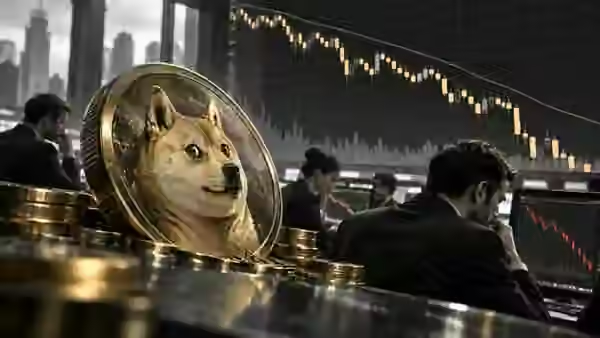
What a rug pull means and what it does not
The phrase rug pull describes a situation in which people connected to a crypto token or its liquidity arrangement exploit buyers by removing liquidity, dumping retained tokens or using privileged contract controls. Not every sharp memecoin collapse is a rug pull: speculative assets can fall because expectations vanish, market makers reduce exposure or a broader crypto selloff hits risk appetite. Calling every loss fraud without evidence obscures the mechanisms readers actually need to evaluate.
A useful analysis separates four possibilities. There is ordinary high-volatility market risk, where traders disagree about price. There is liquidity manipulation, where an actor removes or controls tradable reserves. There is supply abuse, where code or permissions allow unexpected tokens to be minted or user balances to change. And there is promotional deception, where a team creates misleading volume, partnerships or endorsements to draw in buyers.
No checklist can certify a memecoin as safe. Audited code, locked liquidity and famous promotional accounts can all coexist with other problems. The goal is to identify conditions that make severe losses more likely and to understand what kind of evidence would change the assessment.
Start with the actual liquidity pool
A displayed market capitalization is usually token price multiplied by a circulating-supply estimate. It is not the amount of money available for holders to withdraw. A token may show a paper market cap of $20 million while its primary trading pool contains a small fraction of that value in stablecoins or other liquid assets. A large sell order then encounters steep price slippage because bids are limited.
Inspect where most genuine volume occurs: a decentralized exchange pair, a centralized order book, or a collection of tiny pools. For an automated market maker, identify both assets in the pool and any concentrated-liquidity design. Ask whether one wallet or contract can withdraw the liquidity, how long any lock lasts and whether lock conditions can be altered. For order-book venues, study quoted depth at several percentages below the displayed price, not simply the best bid.
Consider a hypothetical $10,000 token purchase into a pool with only $25,000 of the counterasset. The trade may materially change the effective price depending on pool design and fees. The same nominal order in a much deeper market might cause far less movement. This is why a screenshot of market cap or daily volume is not a substitute for testing realistic execution costs.
Examine token supply and concentrated wallets
A token's top-holder table is a starting point, not a final verdict. Some large wallets may belong to known exchanges, custody services or liquidity contracts. Others may be controlled by the same beneficial owner even when split across many addresses. If a small cluster can unload a substantial share of circulating supply, marginal buyers face concentrated sell pressure.
Read the token contract for minting, pausing, freezing, blacklisting, fee changes and upgrade authority. An owner may be able to modify transfer rules or introduce restrictive taxes. An upgradeable proxy can change behavior after an initial audit; a contract renunciation may reduce some risks but cannot undo every vulnerability or social-engineering pathway. Where verified source code is absent, assume you cannot confidently know the token's mechanics.
Compare claimed circulating supply with lock schedules, treasury allocations, vesting contracts and bridge representations. Be alert to a launch where promotional material focuses on a low nominal token price without explaining total supply or diluted valuation. Buying a cheap-looking token can still mean paying an expensive valuation.
Detect fabricated momentum and paid promotion
Rapid social-media growth is not proof of organic interest. Bots can amplify posts, fabricate apparent community engagement and coordinate bursts of trading that create an illusion of liquidity. Watch for repeating promotional language, newly created influencer profiles, unverifiable partnerships and anonymous accounts pushing a deadline to buy before a supposedly imminent listing.
Pump-and-dump behavior has familiar ingredients: heavy promotion, fast price appreciation and insiders selling to late buyers. The US investor education site describes how misleading promotion can create artificial demand before organizers dispose of holdings. Crypto tokens are structurally different from listed equities and regulatory coverage varies, but the underlying warning about promotional manipulation remains useful.
Check whether a public figure has truly endorsed a project through their verified channels, and whether the endorsement is disclosed as sponsored. Fake screenshots, impersonated livestreams and cloned contract addresses are common opportunities for deception. Never enter a wallet's seed phrase, sign an unrestricted allowance or connect a treasury account merely to collect a supposed airdrop.
Test what a realistic exit would cost
Before taking a meaningful position, examine a transaction simulation or quoted route for the actual sell size you might need. Look at expected slippage, DEX fees, transfer taxes and any maximum-sell restrictions. A tiny test purchase that works does not prove a larger sale is allowed; some harmful contracts implement different rules for purchase versus sale or for different addresses.
If using a centralized venue, check whether quoted depth exists beyond the first screen and whether withdrawals are operational. A surge in volume can still coexist with fragile liquidity if the turnover comes from related-party wash trades. Data vendors may classify venues differently, so verify underlying execution where possible.
Remember that liquidity is conditional. A pool can be deep during a marketing campaign and far thinner after enthusiasm fades. In a crisis, a nominal stop order may fill well below the chosen trigger or fail to execute. Risk management should be based on a plausible worst-case exit, not merely the amount you hoped to lose.
An actionable due-diligence scorecard
Write down the contract address and chain from a reliable project channel. Record whether source code is verified, ownership privileges are disclosed, the upgrade path is limited, and vesting terms are visible. Measure top-holder concentration after excluding clearly attributed exchange or pool addresses. Record trading venues, counterasset liquidity, order-book depth, transfer taxes and any withdrawal restrictions. Finally, assess whether promotional claims have independent documentation.
A suspicious project might combine anonymous operators, highly concentrated holdings, editable transfer taxes, thin liquidity and intense short-term marketing. No single factor proves wrongdoing, but clusters matter. Conversely, public code and prominent exchanges do not eliminate valuation risk, smart-contract bugs or social-engineering attacks. The best due diligence can still end with a decision not to participate.
Memecoins can generate compelling stories because extreme returns attract attention. Responsible reporting must also explain how many participants can lose money when trading is illiquid or supply is concentrated. Treat this article as a safety framework, not a recommendation to buy or short any token.
Case study: market cap versus money available to sellers
Imagine a token with 100 million units considered circulating and a last trade at $0.10, creating a displayed $10 million circulating market cap. If the principal decentralized pool has limited quote-asset reserves, a holder cannot assume that selling ten percent of the supply would raise a tenth of the paper market cap. Moving the marginal price down a constant-product curve can create much lower realized proceeds, even before fees.
Volume alone may not rescue the position. Wash trades can generate large reported turnover without committed external bids. In a concentrated pool, liquidity providers may withdraw capital or alter the ranges in which they supply it. Readers should look for accessible exit liquidity at multiple trade sizes rather than make investment decisions from a single market-cap headline.
Permissions that deserve extra suspicion
Verify whether the contract owner can mint additional tokens, change buy or sell taxes, pause transfers, blacklist addresses or swap out a logic contract. Even if the current tax is modest, privileged governance may permit sudden changes. An audit can inspect a particular implementation but cannot guarantee that operators will behave honestly or that a future upgrade will preserve the same rules.
Also examine the launch process. Anonymous teams are not necessarily malicious, but a hidden treasury, inconsistent allocation data, unlocked team tokens and unverified contracts together create a higher-risk picture. A sensible scorecard should record unknowns explicitly. Lack of evidence about a token is not the same as evidence that the token is safe.
What to do if you suspect a fraudulent token
Do not share wallet recovery phrases or sign unexpected transactions to pursue a refund. Revoke risky allowances through trustworthy wallet interfaces where appropriate, preserve transaction identifiers and screenshots, and use official reporting channels relevant to the platform and jurisdiction. Beware of strangers claiming they can recover stolen crypto in return for an upfront payment; that may be a second scam.
If funds are still under your control, consider the operational risks of any attempted exit and confirm the destination contract. For a large loss, an appropriately qualified lawyer or forensic specialist may be able to advise on options, but no third party can credibly guarantee asset recovery. Reporting should describe verifiable transactions and documented control mechanisms rather than accusing specific people on the basis of price declines alone.
Reporting sources & references
These links identify the reporting or public materials on which the article is based; they do not imply our newsroom witnessed the events.
Cite this report
RecoupRev Editorial Research. “Memecoin Rug Pull Warning Signs: Liquidity, Holders and Contract Risks.” RecoupRev, October 12, 2026. https://recouprev.com/article/oct12-memecoin-rug-pull-liquidity-holder-concentration-guide
Revised October 12, 2026 at 16:45 UTC. Refer to the dated report and its reporting sources when citing a specific figure or claim.